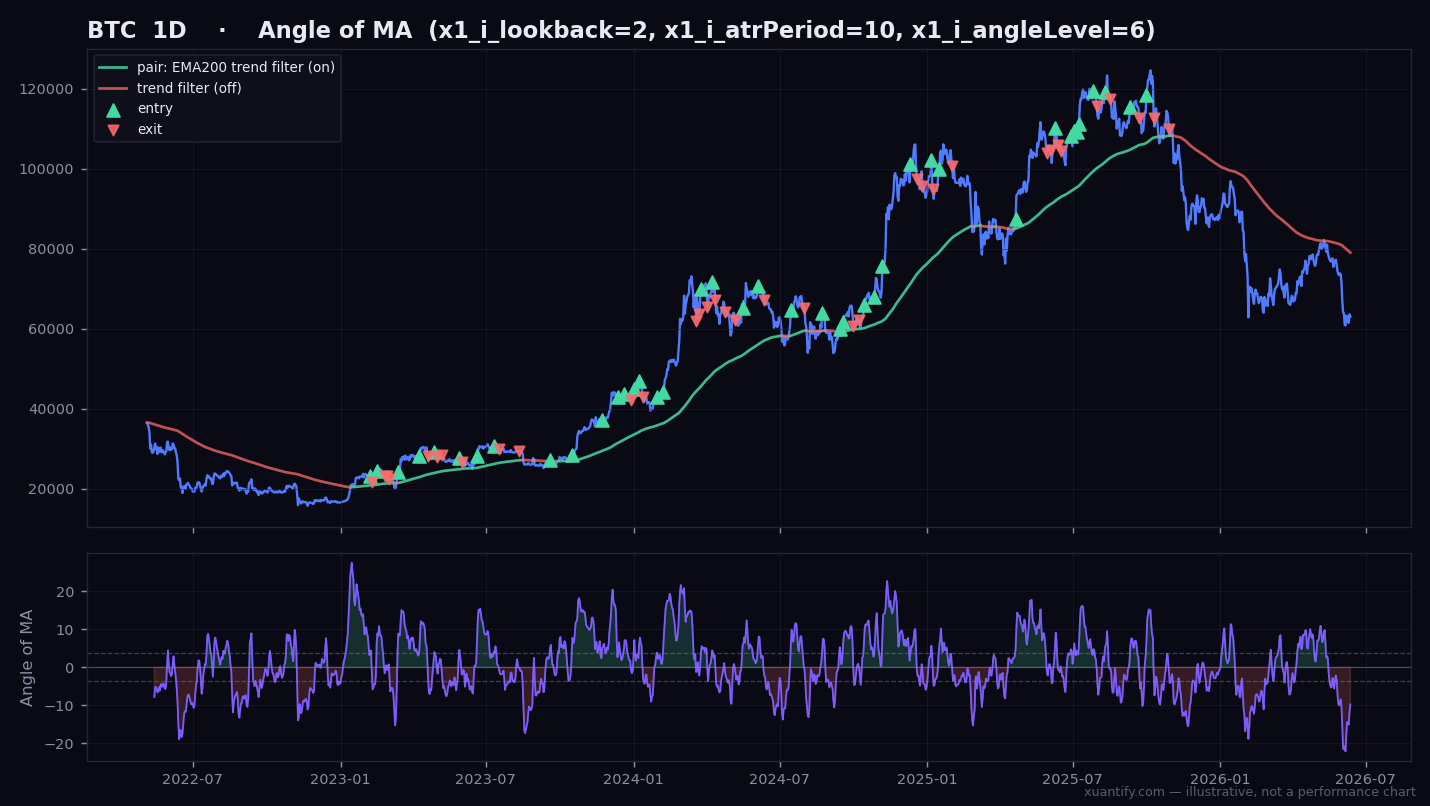
Angle of Moving Average
Most indicators tell you which way a market is going. The Angle of a Moving Average tells you something subtler and genuinely useful: how *strongly* it's going there. A steep slope means a trend with real conviction; a flat one means it's running out of steam. Where people go wrong is trying to trade the angle itself — buy when it tips up, sell when it tips down — which flips too fast to be a reliable trigger. Used as a filter that only lets your other trades through when the trend has legs, it earns its place. Here's how.
Entry · As a filter: only take a momentum or breakout setup while the moving average is sloping clearly in your direction — proof the trend has conviction behind it.
Exit · When the slope flattens or rolls over, the strength you were leaning on is fading — a cue to tighten up, not a mechanical reversal.
We treat the slope as a trend-strength filter — its most useful role — not as a standalone trigger, which is where it earns nothing.
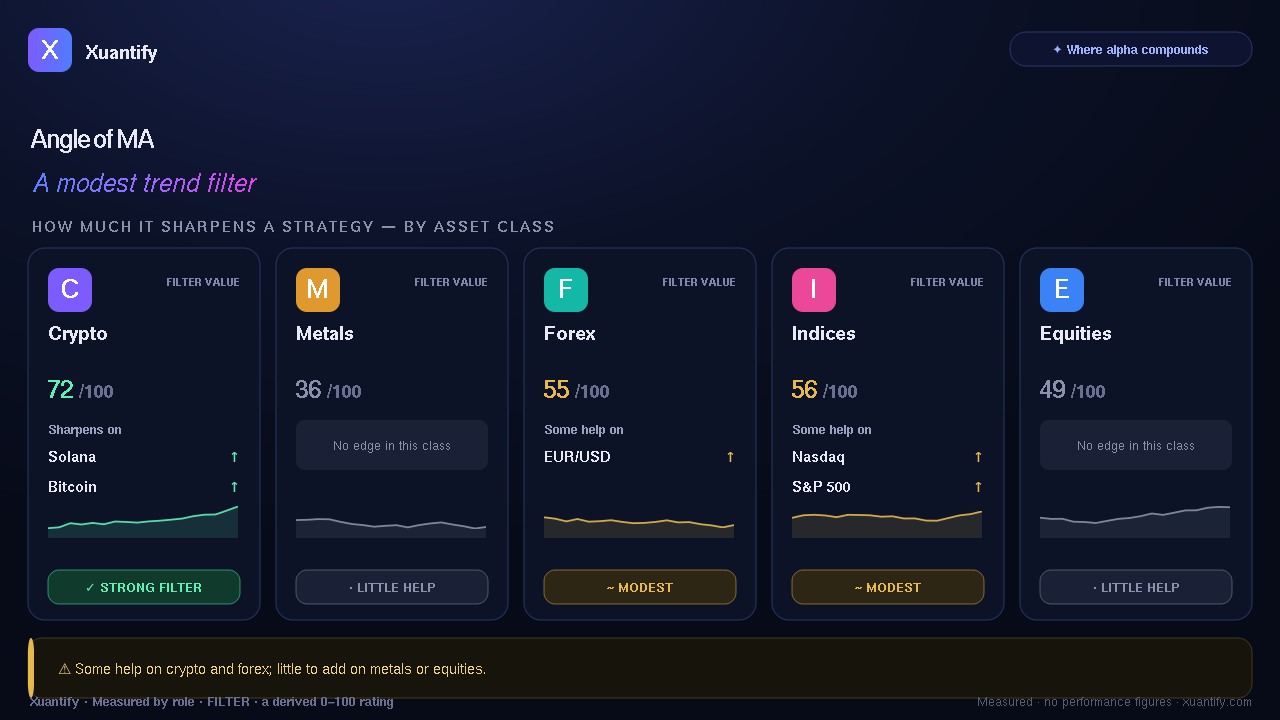
What it's really good at
The Angle is a *conviction meter*: it measures how steeply a trend is moving, not just that it's moving. That's a genuinely useful read — it separates a market that's quietly drifting from one that's moving with force. Used to judge whether a trend is worth trading at all, it's a clean, honest gauge.
Where it shines
It does its best work as a filter on your other signals. A breakout or momentum entry is far safer when the slope confirms real strength behind it — and far more likely to whipsaw when the slope is flat. Letting only the strong-trend setups through quietly cuts a lot of weak trades you'd regret.
Where to be careful
The trap is trading the angle on its own. In volatile or choppy markets the slope flips up and down too quickly, and you get chopped in and out for nothing. It's a gauge, not a trigger — read it to qualify trades, don't fire on it. Used that way it helps; used as a signal it doesn't.
How we test it — and why you can trust it
We don't measure the slope as a standalone signal — that's the wrong job. We measure how much it adds as a filter on top of a disciplined strategy, across five years of real markets, on fresh data, re-checked across many separate periods. So when we say it helps somewhere, it's a lift that held up across the cycle, not a lucky stretch.