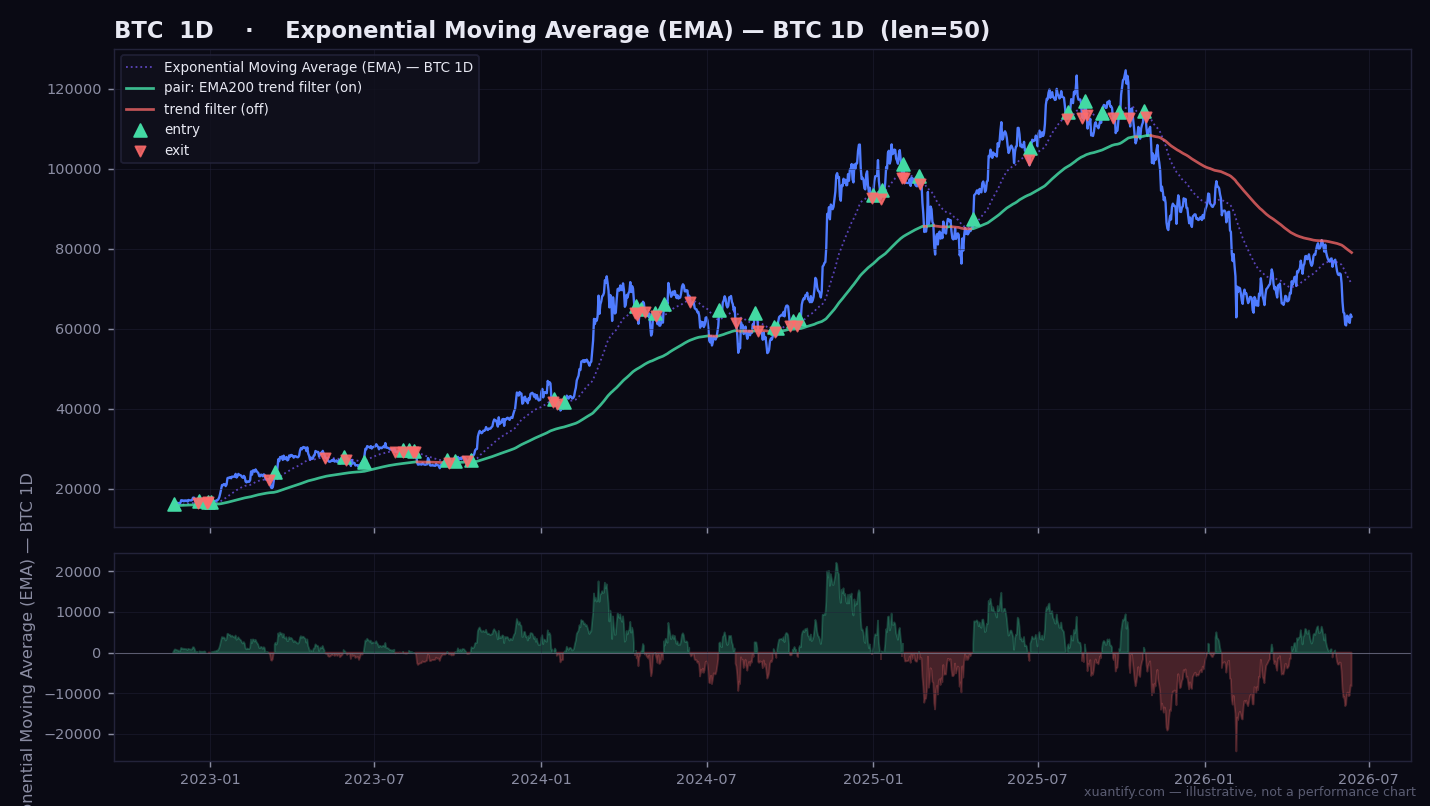
Exponential Moving Average (EMA)
The EMA is the line half the chart leans on, and for good reason — it's one of the simplest, most reliable ways to read which way a market is leaning. Where people go wrong is treating it as a buy/sell button: cross above, buy; cross below, sell. That's the wrong job for it, and it disappoints. Used the right way — as a filter that keeps your other trades on the right side of the trend — it quietly earns its keep. Here's how to think about it, and where it helps most.
Entry · As a filter: only take long setups while price holds above the EMA (an uptrend you can lean with), and step aside or favour shorts while price is below it.
Exit · When price crosses back through the line, the trend you were leaning on has changed — a cue to tighten up or stand down, not a mechanical reversal on its own.
We treat the EMA as a trend-regime filter — its most defensible, most useful role — not as a standalone crossover trigger, which is where it earns nothing.
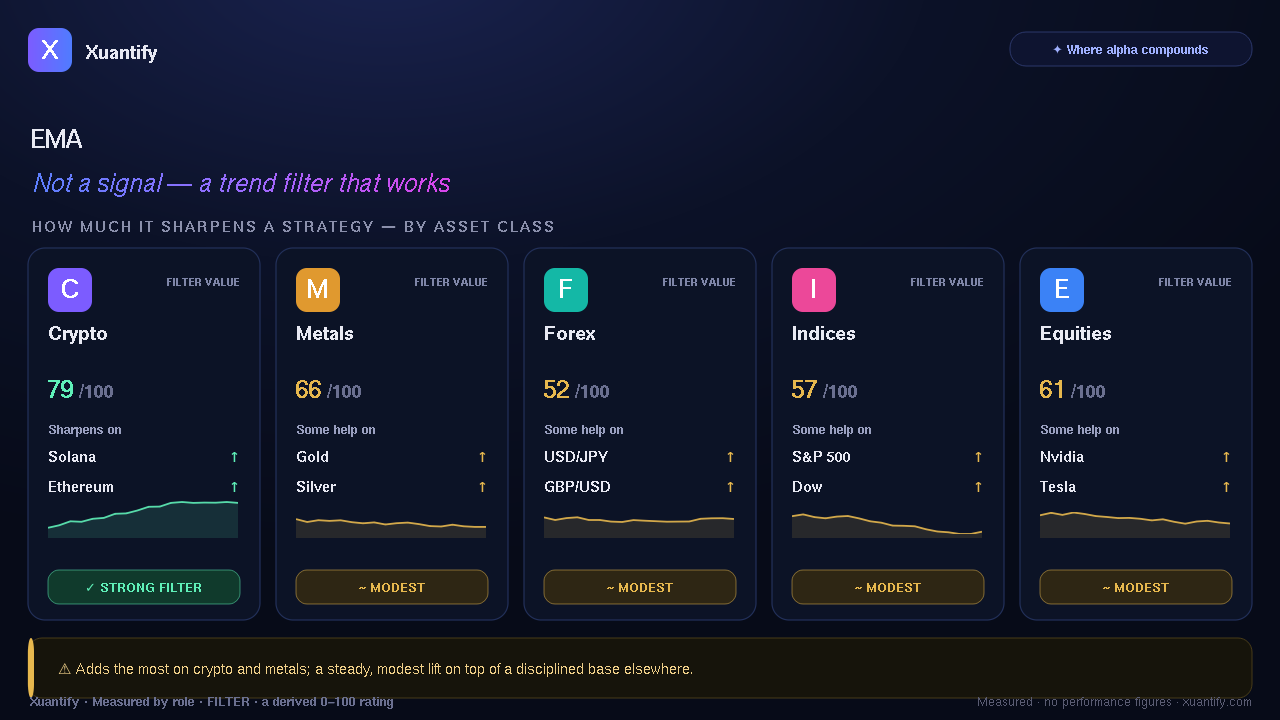
What it's really good at
The EMA is a *direction reader*: a single smooth line that tells you which way a market is leaning right now. Its quiet superpower is keeping you on the right side of that lean — taking trades *with* the trend instead of against it. As a backbone for the rest of your decisions, it's genuinely one of the most useful tools on the chart.
Where it shines
It does its best work where trends are big and decisive — crypto above all. When price holds above the line, you're trading with the wind; below it, you're fighting it. That one filter quietly steers you away from the trades that hurt most: shorting a market that keeps climbing, or buying one that keeps sinking. Simple, but it adds up.
Where to be careful
It is not a buy/sell button. Flipping in and out purely on the crossover whipsaws you in choppy markets and in ones that grind relentlessly one way — you pay costs each time for nothing. The fix is simple: use the line to *qualify* your trades, not to fire them. Knowing the difference is the whole point.
How we test it — and why you can trust it
We don't measure the EMA as a standalone signal — that's the wrong job and it flatters nothing. Instead we measure how much it *adds* on top of a disciplined strategy, across five years of real markets, on data the tool hasn't seen, re-checked across many separate periods. So when we say the EMA filter helps somewhere, it means it genuinely lifted results across the cycle — not a lucky stretch.