Fair Value Gap (FVG) Order Blocks
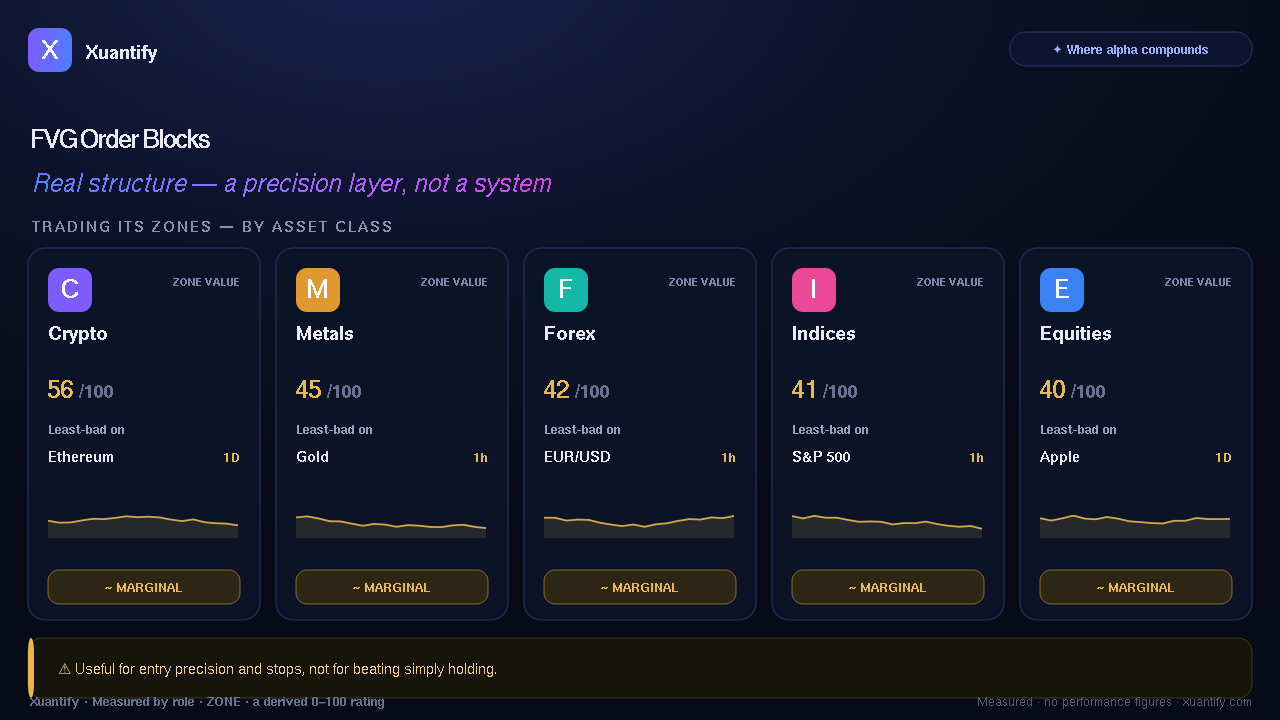
The honest surprise with fair-value-gap order blocks: the zones are real — price genuinely reacts to them. That part isn't hype. The catch is that *reacting to a level* and *being a tradeable signal* are two different things. We measured it every way, including exactly as the method is taught. The verdict is encouraging if you use them right: FVG zones are a precision layer inside a disciplined plan — they sharpen your entries and tighten your stops — but they're not a magic buy/sell button. Here's how to get the value without the trap.
Entry · As precision: when you already want to trade a direction, use an FVG zone as a sharper place to enter on a retest — better price, tighter risk — rather than triggering blind off the zone.
Exit · Anchor stops to the structure of the zone; let the level define where the idea is wrong, instead of a guessed distance.
We treat FVG zones as an entry-precision and stop-placement layer — their real value — not as a standalone trigger, which doesn't beat simply holding.
What it's really good at
FVG zones mark *where price is likely to react* — genuine pockets of supply and demand left behind by fast moves. That's real and useful: it gives you specific, logical places to look for entries and to anchor stops, instead of acting at a random price. As a precision tool, it sharpens trades you were already going to take.
Where it shines
Its best use is entry precision and stops inside a directional plan. If you already like a market's direction, waiting for a retest of an FVG zone gets you a better price and a tighter, more logical stop. Used as a precision layer — especially in the direction of the bigger trend — it quietly cuts your losses and improves your risk.
Where to be careful
The trap is trading the zones mechanically on their own. Done blind — buy every bullish gap, short every bearish one — it costs you, especially against strong trends that swallow gaps before they can be traded. The zones are a map for precision, not a system to run unattended.
How we test it — and why you can trust it
We measured FVG zones every way — naive, and exactly as the method is taught (structure stop, risk-to-reward target, higher-timeframe trend) — across five years of real markets, on fresh data, re-checked across many separate periods. The zones are real; the mechanical system isn't. So we tell you precisely where they add value and where they only get in the way.
